Walk onto almost any active construction site across North America, and you will hear the familiar symphony of progress: the roar of diesel generators, the sharp crack of nail guns, and the hum of concrete saws. You will also see workers taking logical safety precautions—wearing hard hats, steel-toed boots, high-visibility vests, and fall protection harnesses.
Yet, some of the most severe hazards on a jobsite are invisible to the naked eye.
Dust, fumes, mists, fibres, and toxic gases contaminate the air on construction projects every single day. Unlike a sudden slip or fall, exposure to airborne toxins rarely causes an immediate emergency. Instead, toxic particulates enter the lungs silently, causing microscopic damage that accumulates slowly over years or even decades. By the time a worker notices persistent shortness of breath, a chronic cough, or chest tightness, permanent pulmonary scarring or lung disease may already be set in.
For employers, protecting worker health is both a legal mandate and an operational necessity. Occupational respiratory illnesses lead to lost time, rising workers’ compensation claims, reduced productivity, and tragic human costs.
Understanding the primary respiratory hazards present in construction—and implementing proactive medical surveillance—is critical to sending every worker home safe.
The Big Four: Major Airborne Hazards in Construction
Construction workers are routinely exposed to dynamic environments where materials are cut, ground, sanded, welded, or demolished. Four primary categories of airborne contaminants present severe risks to long-term lung health:
1. Respirable Crystalline Silica (RCS)
Crystalline silica is a basic component of soil, sand, granite, and synthetic stone, as well as common construction materials like concrete, brick, mortar, and drywall compound.
When cutting, drilling, chipping, or grinding these materials, microscopic dust particles are released into the breathing zone. These particles are up to 100 times smaller than a single grain of ordinary beach sand, making them small enough to penetrate deep into the alveolar sacs of the lungs where natural clearing mechanisms cannot remove them.
- The Health Risks: Inhaling respirable silica leads to silicosis, an irreversible and progressive lung disease characterized by inflammation and scar tissue. Silica exposure significantly increases the risk of developing lung cancer, chronic obstructive pulmonary disease (COPD), and kidney disease.
2. Asbestos
Though heavily regulated and phased out of modern manufacturing, asbestos remains a major hazard in renovation, retrofit, and demolition projects involving structures built prior to the late 1980s. Asbestos fibers were widely used in pipe insulation, vinyl floor tiles, textured ceilings, siding, and roofing materials.
- The Health Risks: Disturbing asbestos-containing materials releases microscopic mineral fibers. When inhaled, these fibers become lodged in lung tissue and the surrounding lining (pleura). Decades later, this exposure can manifest as asbestosis (severe lung scarring), lung cancer, or mesothelioma—a rare and aggressive cancer of the chest cavity lining.
3. Welding Fumes and Volatile Gases
Welding, cutting, and brazing metal releases a complex plume of airborne metal oxides, silicate particles, and toxic gases. The composition varies based on the metals being joined, filler rods, fluxes, coatings (like zinc plating or paint), and shielding gases.
- The Health Risks: Short-term exposure to welding fumes causes acute irritation of the eyes, nose, and throat, along with “metal fume fever” (flu-like symptoms). Chronic exposure to heavy metals like hexavalent chromium (found in stainless steel welding) or manganese causes neurological damage, occupational asthma, and lung cancer. Furthermore, heavy equipment exhaust in enclosed spaces introduces carbon monoxide and diesel particulate matter—a known human carcinogen.
4. Synthetic Mineral Fibers, Dusts, and Isocyanates
Construction activities generate vast amounts of nuisance dust from wood, insulation materials (glass wool, stone wool), drywall, and composite wood products containing formaldehyde. Additionally, spray polyurethane foams, commercial coatings, and adhesives release isocyanates—one of the leading causes of occupational asthma.
- The Health Risks: Continuous irritation from general construction dust reduces lung function over time. Isocyanates sensitize the respiratory system; once sensitized, even minuscule future exposures trigger severe, life-threatening asthma attacks.
The Hierarchy of Controls in Respiratory Safety
Under Occupational Health and Safety (OH&S) guidelines, relying solely on personal protective equipment (PPE) is not enough. Employers must apply the Hierarchy of Controls to mitigate respiratory risks:
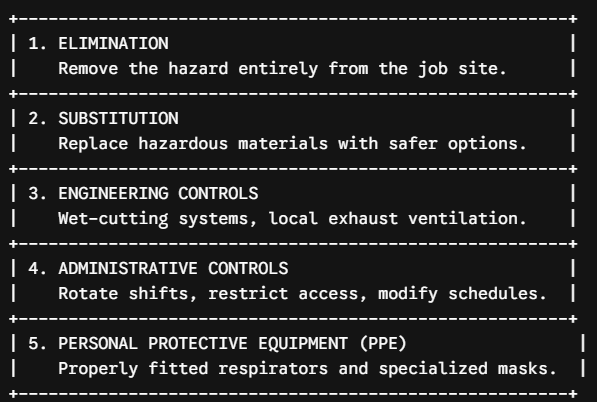
While engineering controls like local exhaust ventilation (LEV) and integrated wet-cutting attachments dramatically reduce airborne dust concentrations, residual hazards frequently remain. When engineering controls cannot fully suppress airborne risks below occupational exposure limits (OELs), Respiratory Protective Equipment (RPE) becomes the final line of defense.
However, simply hanging a box of N95s or half-facepiece respirators in the tool trailer does not guarantee protection.
The Missing Link: Why Respirators Fail Without Mask Fit Testing
A respirator only protects a worker if it forms an airtight seal against the face. If a gap exists—even one invisible to the eye—airborne hazards take the path of least resistance, bypassing the filter entirely and entering the worker’s lungs.
Facial structure, weight fluctuations, dental work, scars, and even a single day’s worth of facial hair growth break the seal of a tight-fitting mask. This is why governing bodies (including CSA Standard Z94.4 and OSHA 1910.134) require mandatory Respirator Mask Fit Testing before an employee wears a tight-fitting mask on the job, repeated at least every two years or whenever facial changes occur.
At SureHire, we provide comprehensive Respirator Mask Fit Testing to ensure your workers receive the exact protection their equipment promises.
Quantitative vs. Qualitative Fit Testing
SureHire offers both primary methodologies for respirator fit testing:
| Feature | Qualitative Fit Testing (QLFT) | Quantitative Fit Testing (QNFT) |
|---|---|---|
| Methodology | Passes/fails based on the worker’s sensory detection (taste/smell) of a harmless test agent (e.g., Bitrex or Saccharin) while wearing the mask. | Uses digital instrumentation (such as a PortaCount® machine) to physically measure particle concentrations inside and outside the mask. |
| Data Produced | Subjective Pass/Fail result. | Objective numerical measurement (“Fit Factor”). |
| Best Used For | Disposable N95/KN95 masks and half-facepiece air-purifying respirators. | High-hazard environments, full-facepiece respirators, and stringent corporate compliance standards. |
During a fit test session, SureHire’s certified testers evaluate mask fit while guiding workers through real-world dynamic movement protocols—including head turns, deep breathing, speaking out loud, and bending over—to simulate actual jobsite conditions.
Proactive Monitoring: Catching Lung Damage Early with Spirometry
Mask fit testing ensures protection is working today, but how do you measure whether a worker’s lung health is holding up over time?
Because occupational lung diseases develop over prolonged periods, relying on visible symptoms is dangerous. Once a worker experiences noticeable shortness of breath, significant pulmonary capacity may already be permanently lost.
This is where Spirometry (Lung Function Testing) serves as a vital occupational health tool.
What is Spirometry?
Spirometry is a quick, non-invasive pulmonary function test (PFT) that measures how much air a worker’s lungs can hold and how rapidly they can forcefully exhale that air.
During the test, a worker takes a maximum inhalation and then blasts the air into a digital spirometer mouthpiece as hard and fast as possible for several seconds.
The spirometer calculates key health metrics:
- FVC (Forced Vital Capacity): The total volume of air exhaled forcefully in one breath.
- FEV1 (Forced Expiratory Volume in 1 Second): The volume of air exhaled during the crucial first second of the blow.
- FEV1/FVC Ratio: A key index used to differentiate between obstructive lung conditions (like asthma or industrial bronchitis) and restrictive conditions (like silicosis or pulmonary fibrosis).
Why Baseline and Periodic Spirometry Matter
Establishing a baseline spirometry test during the pre-employment or pre-placement screening phase provides a clear benchmark of a worker’s starting pulmonary function.
By conducting regular periodic spirometry re-tests, employers can compare results against the baseline. If a worker shows an abnormal decline in FEV1 or FVC over time, safety managers can intervene immediately—investigating jobsite controls, re-evaluating mask seals, or reassigning the worker—before irreversible health loss occurs.
Building a Complete Occupational Lung Health Program
Protecting workers from airborne hazards requires an end-to-end strategy combining clear policies, proper equipment, and medical surveillance.
- Hazard Identification & Exposure Assessment – Identify silica, asbestos, fumes, and particulates.
- Implementation of Engineering & Admin Controls – Wet cutting, extraction systems, work rotation.
- Pre-Employment Baseline Medical Surveillance – Spirometry testing & exposure questions
- Equipment Matching & Mask Fit Testing – Qualitative or Quantitative testing for proper seal.
- Ongoing Monitoring & Periodic Re-Testing – Annual/biennial re-testing and data tracking via SureLink.
By structuring your safety strategy around these steps, your organization ensures regulatory compliance while fostering a work environment where employee health is protected.
Protect Your Workforce with SureHire
Occupational lung disease is preventable—if you have the right monitoring and protective protocols in place.
SureHire is a trusted partner in occupational health testing across North America. We offer tailored, flexible solutions designed to minimize jobsite downtime while maximizing compliance and worker safety:
- Mobile & On-Site Testing: Our mobile technicians come directly to your jobsite or facility to perform mask fit testing and spirometry on your schedule.
- Extensive Clinic Network: Access convenient in-facility testing options across our nationwide network.
- SureLink Platform: Book appointments, manage employee profiles, and view real-time test results securely online through our centralized portal.
Don’t wait for symptoms to surface. Take a proactive stance on jobsite respiratory health today.
- Ready to safeguard your workers’ lung health? Request a Quote for Respirator Mask Fit Testing or learn more about our Spirometry Testing Solutions.
- Speak with an expert: Contact the SureHire team directly to set up a lung health program for your workforce.